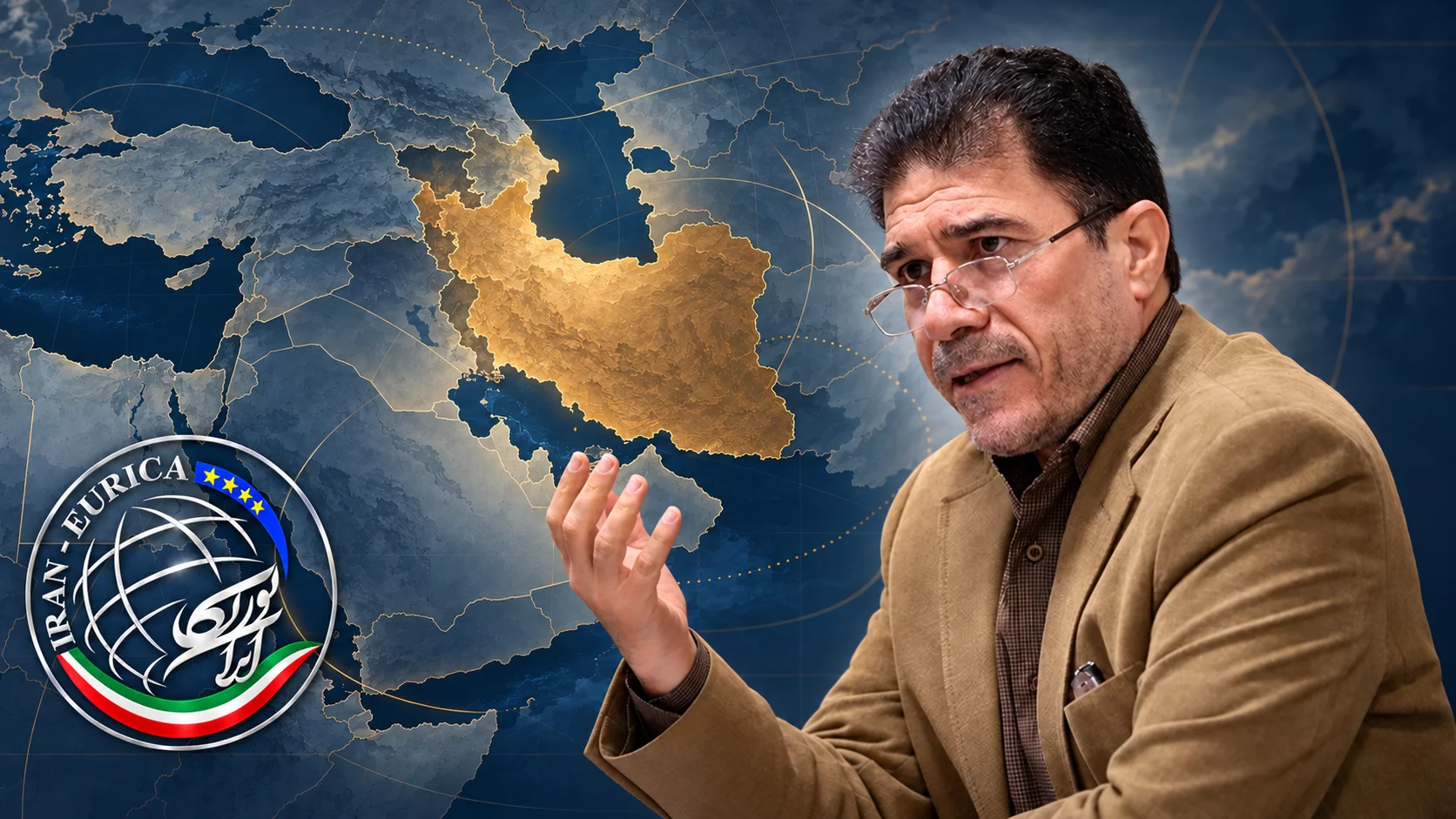
Interview with Dr. Dehghani, Secretary of the Strategic Council on Foreign Relations of Iran
Seyyed Jalal Dehghani Firoozabadi received his PhD in International Relations in 1995 from the University of Brussels, Belgium. He is currently a Full Professor of International Relations at Allameh Tabataba’i University and has authored numerous works on the foreign policy of the Islamic Republic of Iran and International Relations theories. He is also a member of the editorial board of several of the most important scientific-research quarterlies in the fields of political science and international relations in Iran, and the scientific secretary of the Tehran Security Conference.
Dr. Firoozabadi has various political and executive positions in his record, including serving as Iran’s Cultural Counselor in the UAE and formerly as the Political-Legal Deputy of the Islamic Parliament Research Center. In December 2025, he was appointed as the Secretary of the Strategic Council on Foreign Relations of Iran by a decree from Kamal Kharrazi.
What is the assessment and perception of the Islamic Republic regarding the status of the balance of power in the region? How do you think the future trend [of the balance of power] will be? Is [this balance] in favor of Iran or to its detriment? Is it stable or unstable?
Dr. Seyyed Jalal Dehghani Firoozabadi: Generally speaking, the 12-day war was a turning point in the region. In my opinion, the situation of the West Asia and Persian Gulf region must be divided into before and after the 12-day war. Of course, the events of October 7 were also a turning point; however, the 12-day war was much more decisive for the regional security order. As Netanyahu announced on the day of the incident or the day after, Al-Aqsa Flood was Israel’s September 11. [This statement signifies] a type of historical simulation with the September 11 [events] for the United States, meaning that we (Israel) want to do in the region what the United States did in the international system. At that time, the Americans sought to exert their undisputed hegemony by emphasizing militarism, the use of power, and territorial occupation. This meant a return to geopolitics and the use of hard and military power to exert a type of malignant hegemony through the use of force. I believe that Israel, with U.S. support, seeks to reconstruct and reproduce such an order in the region to achieve hegemony. Of course, some believe that the security strategies of the United States and Israel in the region are not identical. [Meaning that] Israel seeks to create hegemony, while the United States seeks to maintain the balance of power in the region. But I think, considering the explanations Trump later gave stating that “I” was directing the war—one cannot distinguish much difference between the two. [In fact,] we are facing an order based on U.S. proxy hegemony via Israel. It might be said that this order is a two-pillar order, similar to the Nixonian two-pillar order, consisting of Israel as the military-technological pillar and Saudi Arabia or the collective of Arab countries in the Persian Gulf as the economic and financial pillar. In other words, the transformation in the regional order is occurring based on the Abraham Accords.
After the 12-day war, the pillars of the regional order essentially changed entirely. After the numerous operations Israel conducted in the region, in my opinion, one of the fundamental elements and pillars of Iran’s defense-security doctrine namely, the reliance on extraterritorial deterrence was transformed. [This strategy] was weakened and lost its function after October 7 and the numerous operations. Therefore, this strategy was deterrent as long as it existed, and because it was weakened, Israel directly attacked Iran. Thus, we need to rethink our defense doctrine and extraterritorial deterrence. Regardless of whether extraterritorial deterrence is functional or not, we need to strengthen our territorial and national deterrence. We need “inward-oriented balancing.” In discussions related to “balancing,” there are two types: outward-oriented balancing and inward-oriented balancing. Outward-oriented balancing includes strategies such as regional and international alliances as well as extraterritorial deterrence. After the 12-day war and Israel’s attack on Doha, a general sense of threat from Israeli hegemony has formed in the region. Iran is trying to use this threat perception to create a new type of outward-oriented balancing.
Regarding the fact that the regional balance has changed into an imbalance to Iran’s detriment and that Iran is trying to somehow revive it through an outward-inward approach, please explain further.
Dr. Seyyed Jalal Dehghani Firoozabadi: It has been and remains my belief that Iran’s deterrence and national power in general are based on four pillars, one of which undoubtedly consists of military power. Despite all technological developments and soft power which are, of course, undeniable military and hard power remains one of the important determining elements of national power. Currently, the United States has increased its military budget to 1.5 trillion dollars. If military and defense power have become meaningless and obsolete, why are the Americans increasing [their military budget]? China is doing the same. In other words, I must say that military power is necessary but not sufficient. Therefore, our military power, and at its head, missile power, is one of the components of Iran’s national power. [Regional] presence was also one of the pillars and reinforcing elements of our national power and deterrence; if it has been weakened now, it must be strengthened again. We might make a change in the previous strategy, but the principle [of this strategy] is necessary. We might also put deterrence through integration and cooperation on the agenda; that is, within the framework of regional multilateralism and the idea of “Strong Iran, Strong Region.”
The most important element of power, however, is Iran’s people-based power. Firstly, the Islamic Revolution of Iran is the most popular revolution in history; meaning that all revolutions were won with guerrilla forces, vanguards, parties, and the like, and the only revolution won with the presence of the general public was the Iranian revolution. Thus, the most important element of Iran’s Islamic Revolution is the presence of the people. In the 8-year war, although the armed forces practiced great self-sacrifice, devotion, and bravery, it was not enough because we were engaged with half the world. Ultimately, it was this popular mobilization that preserved the country. After that, in various periods, the most important factor in Iran’s deterrence and national power has been popular support and satisfaction. After the 12-day war as well, the most important element of national power is Iran’s people-based power, which we must preserve. Incidentally, I think that the 12-day war project was flawless in terms of strategic, security, military, and political design. The only flaw in this project was the fourth pillar. The Israelis thought the people would cooperate with them, but they did not, and this project failed. Therefore, if we seek to strengthen our national power elements, all these pillars must exist in Iran’s national power. The sum of these pillars is power-generating. Undoubtedly, economic and technological power is also very important in itself. To conclude, the balance has changed, and to maintain the balance, restore the previous balance, or establish a new balance, we must perform a re-balancing; of course, in my opinion, restoring the previous balance might not be realistic. At the level of regional balance, I feel that even the Turks and the Arabs have reached this historical understanding and awareness that Iran can be a balancing weight in the region.
What do you see as the elements affecting this new balance of power?
Dr. Seyyed Jalal Dehghani Firoozabadi: If we accept that the previous order has been disrupted and a new order is taking shape (sometimes we call it a transition period), then the most important concern for regional and extra-regional actors is appropriate positioning in the new order. Meaning, where does everyone (each country) stand? Everyone (each country) tries to occupy or be placed in the best position it can. Saudi Arabia and the UAE have good relations with each other, but each loves itself more than its friend and wants to occupy the best place. The members of the Gulf Cooperation Council are united against common threats, but there are also competitions and differences among them. These countries usually turn to the differences between them when they feel the external threat has weakened. For example, now that a power vacuum has been created in Syria, Israel, Turkey, Qatar, and Saudi Arabia are all trying to take a larger portion of this cake. Naturally, Turkey thought that the main part of this cake (the lion’s share), i.e., the big piece, would go to it; but Israel did not allow the Turks to do anything in this regard. Therefore, in the Syrian issue, Turkey is an important actor, whereas perhaps until before the fall of Assad in Syria, Turkey was one of the most ineffective actors in regional developments in the Middle East, because it could not define a specific position for itself and all positions had been captured before. But now, Turkey can define a position for itself through Syria. Second is Saudi Arabia. This country had set conditions for normalizing relations with Israel even before October 7, and after this event, I think these conditions have become more difficult; meaning it demands more concessions for normalization. The UAE also acts in full alliance with Israel. This area is also a field of indirect competition between Israel and Saudi Arabia. It is true that these countries are U.S. allies, but nonetheless, they have defined a sphere of national interest influence for themselves. These countries believe they are allies on a macro scale, but they have competitions within themselves. The UAE, backed by Israel, competes with Saudi Arabia and wants to gain a better position even within the Gulf Cooperation Council. Pakistan is a new force that has recently entered and is directly effective and decisive in the regional order. Which direction Iraq takes can be decisive that is, balancing. Iran also, regardless of any kind of assessment other actors have, is a pole of power in terms of dimensions and elements of power and holds a position in the first rank. You might say that Iran was once a hegemon, but now, at the level of Britain after 1960, it has turned into a conventional regional power. Naturally, extra-regional powers are also decisive.
How do you see the agency of Europe and the United States?
Dr. Dehghani Firoozabadi: The Americans want to devolve their responsibility to that same two-pillar order I mentioned earlier meaning to Israel and Saudi Arabia, or to the GCC collective. This matter is explicitly stated in the 2025 U.S. National Security Strategy. Another point regarding this strategy is that all regions no longer have equal importance for the United States; therefore, a type of prioritization is being carried out. In this same national security document, it is stated that the Western Hemisphere is the first priority of U.S. foreign policy, and the South China Sea, in competition with China, is the second priority. Regarding the Middle East, this document states that this region does not have its previous primary importance. According to this document, the Middle East and other regions that have been U.S. allies must themselves take responsibility for their own security (offshore balancing and intervention only if necessary). The United States has red lines and only intervenes in the region if these red lines are endangered. For example, if Israel’s security is endangered, the balance of power is disrupted, the enemy dominates energy resources, or shipping, oil, and energy transfer lines are disrupted, the United States intervenes directly. Therefore, the U.S. seeks minimal intervention with maximum profit, like Venezuela. It is also important to note that the Vietnam and Iraq syndromes, which once dominated U.S. foreign policy, are now fading. It is also mentioned in the U.S. National Security document that we act with strikes. Trump, who claimed to oppose war, does not consider such operations as war and claims that such operations have no cost for him and even lead to access to resources. This shows that the United States is still the director of the regional order, but it tries to devolve its responsibility to Israel and the Arabs. This is while there is also a competition among these members themselves to occupy the position of the pillar of the order. For example, if a two-pillar order is to be established, there must be a balance between the two pillars, not that the principle lies with Israel and the rest merely follow it; meaning it [Israel] wants to establish hegemony on behalf of the United States.
In relation to Europe, since the 1950s, one of the fundamental security-defense questions was what position, role, and function Europe has. Of course, Europe was one of the main pillars of NATO alongside the United States. But especially after the 1970s, when détente between the Soviet Union and the United States took shape, the Europeans felt endangered by the possibility of becoming a subject of trade between the U.S. and the Soviet Union. Therefore, at this time, talk of European independence became more serious. Within the European Union, two groups existed: Atlanticists and Europeanists. After the collapse of the Soviet Union, Atlanticism gained a sort of dominance. Therefore, in the Middle East regional order, Europe mostly follows the United States. That is, it is the U.S. that defines a role for Europe. Of course, in economic and technological fields, based on the diversification of relations by the Arabs which we sometimes refer to as “Hedging” Europe can play a role in the region. Of course, hedging is meant in the field of economics. Therefore, the European Troika, and mostly France and Britain, because they have been traditional powers in the region, can play a role. However, the only place where Europe and the United States agree is Iran.
Regarding the United States, it is clear; but in principle, does the emerging order create a threat perception for Europe? To which my guess is your answer is negative!
Dr. Dehghani Firoozabadi: No! Especially regarding Israel in the 12-day war and even before that, Europe showed the most supportive positions in both word and deed. Meaning that it provided comprehensive support for this war both within the framework of NATO and individually. Such positions had not been seen before, because one of the characteristics of European foreign policy was that they used to say that in the Middle East, and especially in the Arab-Israeli conflict, Europe mostly takes a stance in support of the Arabs. But recently, European countries, especially Germany, provide unconditional support for Israel. Therefore, they too have concluded that a two-pillar order based on Israeli hegemony or the two pillars mentioned is taking shape, and they have no competition or disagreement with the United States in this regard. The pressure on Iran is also taking shape within this framework. In other words, in the relationship between Iran and Europe, not only are bilateral relations important, but a major part of these relations is focused on the regional order. Europe too has concluded that now might be a historical turning point against the Islamic Republic.
In such an atmosphere, do you think there is essentially a possibility for Iran-West cooperation, specifically Iran and Europe?
Dr. Dehghani Firoozabadi: In the short term, no! I do not want to discuss theoretically; but a constructivist view is perfectly applicable here. When one side takes a friendly gesture and the opposing side gives a hostile response, tension escalates and hostility is not only reproduced but doubled. During the Muscat negotiations, we were attacked while negotiating. Thus, diplomacy became completely discredited. This matter leads some to the conclusion that diplomacy and negotiation, instead of leading to deterrence, are themselves a factor for war. In other words, returning the diplomatic conditions between Iran and the United States to before the 12-day war is itself a difficult project. That we might want to use a new initiative now I am not saying it is impossible, but it has become much harder. Especially since the opposing side thinks that Iran is in its weakest period and has lost its power levers. Therefore, an agreement means surrender.
Regarding Europe as well, after recent events, especially the reckless support for Iran’s internal developments and direct intervention in them, the diplomacy option has truly become harder, but diplomacy never shuts down. You can use diplomacy even in the worst conditions. Here we must distinguish between diplomacy and compromise, and diplomacy and surrender. These are three different concepts. Coincidentally, one of the places where diplomacy becomes a necessity is during crises and war. In these conditions, we need diplomacy more.
Regarding Europe, diplomacy has become harder, meaning it requires more effort. We have tried almost all imaginable diplomatic ways to resolve the problem with the West, both the United States and Europe, and we saw no result or mutual reaction. I have said many times that if the collective West, and especially the United States, recognizes three things, the problem is solvable. First, the existence of the Islamic Republic of Iran, regarding which the situation has worsened; second, the identity of the Islamic Republic of Iran, regarding which the situation has also worsened; and third, Iran’s national interests, regarding which there is essentially no acceptance. Historically, I have said many times that if the collective West recognizes these three items, while accepting differences or even enmity, we can have a competitive coexistence with each other. Meaning you can be enemies with each other but have coexistence together. In my opinion, conditions for achieving a state of coexistence have become much harder.