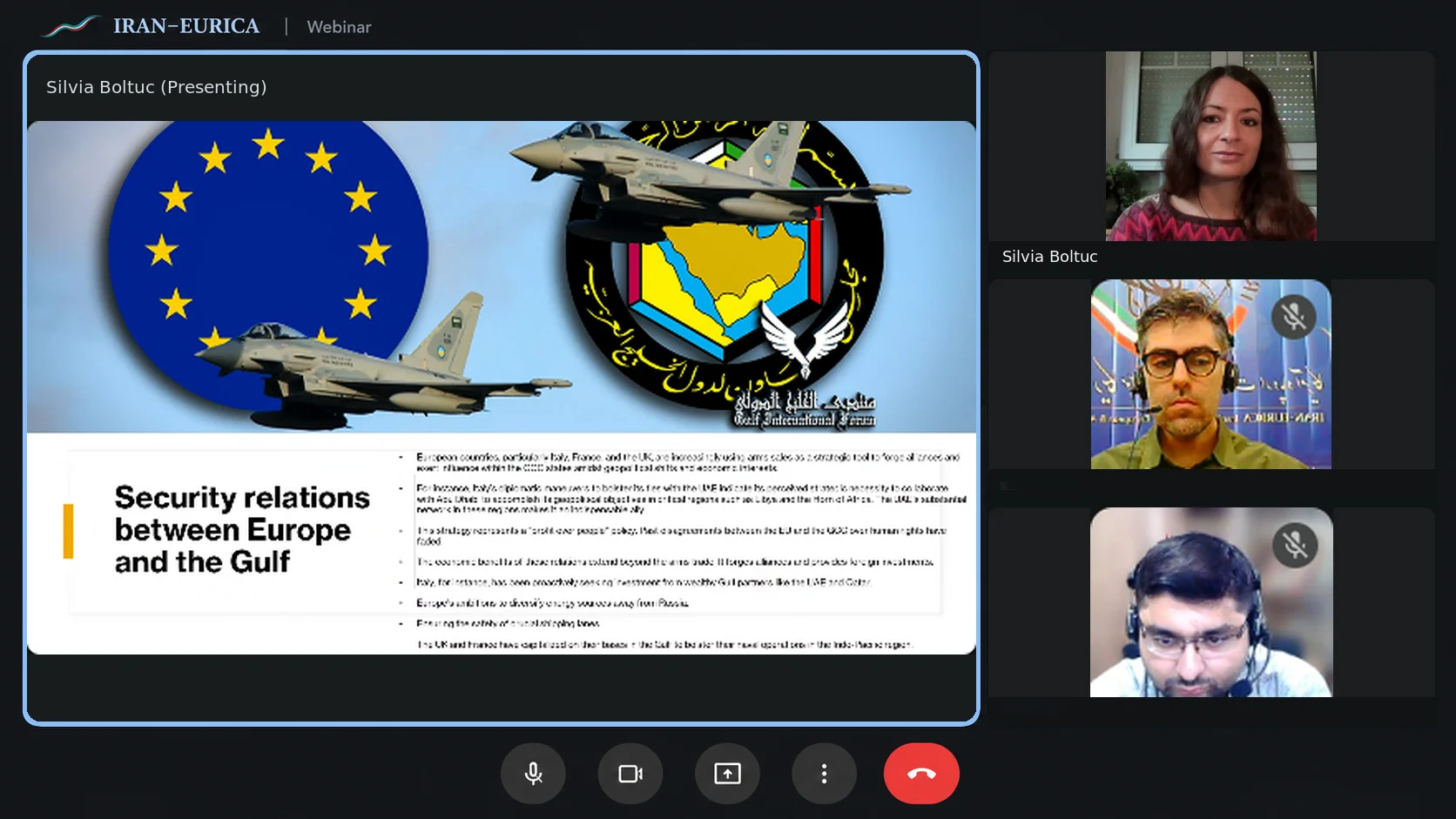
Guest Speaker: Dr. Silvia Boltuc (Italian analyst and founder of the media outlet “SpecialEurasia”)
Date: Wednesday, October 22, 2025
Summary of Dr. Boltuc’s Remarks:
- Regional stability is of vital importance to European interests in terms of energy, access to transportation infrastructure, military bases, and other areas. The main traded commodities are fuels, which account for more than 75% of Europe’s imports from the Gulf Cooperation Council (GCC) countries. The Persian Gulf holds approximately one-third of the world’s oil reserves, making it vital to Europe, particularly following the war in Ukraine, when Europe began seeking to diversify its energy sources because of its heavy dependence on Russia. In 2023, the value of Europe’s imports from the Gulf countries amounted to €76.3 billion, with mineral fuels, oil, and gas accounting for 75% of total imports.
- In 2020, Saudi Arabia was the largest supplier among the Gulf countries, accounting for 7.8% of Europe’s total global crude oil imports. Qatar was also a major supplier of liquefied natural gas (LNG), and its role is growing. Qatar was the largest supplier of natural gas, and its role continues to expand. A 15-year agreement has been signed between Germany and Qatar for the export of two million tons of liquefied natural gas annually from Qatar to Germany, beginning in 2026. Germany is the largest gas market in Europe, making this agreement highly significant. It could even pave the way for the re-export of Qatari gas from Germany.
- Due to humanitarian and political concerns regarding the domestic situations in certain Gulf countries, some European countries, including Italy, had previously imposed restrictions on imports from or exports to these countries. However, given the strategic importance of the region, these restrictions have recently been lifted, and trade volumes are expected to increase. Europe is also interested in importing energy from Central Asian countries such as Kazakhstan and Turkmenistan.
- Regarding shipping routes, the European Union held its first high-level political summit, entitled “Strategic Partnership for Peace and Prosperity,” in Brussels in October 2025. This summit was the result of efforts by Luigi Di Maio, the former Italian Minister of Foreign Affairs and the European Union’s first Special Representative for the Gulf. At this summit, there were three main objectives for establishing relations with these countries. From a geopolitical perspective, the strategic objective was the most important. Therefore, I would say that the title “Peace and Prosperity” does not encompass all the issues that were discussed.
- The Middle East, as a region, is an important market for European weapons, accounting for approximately 24% of Europe’s total global arms sales between 2018 and 2022. In 2024, German arms exports reached a new record of €12.2 billion. Saudi Arabia was one of the main recipients, with Germany exporting more than €132 million worth of weapons to the country. Qatar also received more than €100 million worth of German weapons during the same period.
- European countries, particularly Italy, Germany, France, and the United Kingdom, use arms sales as a strategic instrument to build alliances and expand their influence in the Persian Gulf, especially amid strained relations with Russia. It can be said that past disagreements between the European Union and the member states of the Gulf Cooperation Council over human rights issues have gradually faded. The Persian Gulf region is simply too strategically important to us, and therefore we cannot exert excessive pressure on these countries regarding human rights.
- The United Kingdom and France have used their bases in the Persian Gulf to strengthen their naval operations in the Indo-Pacific region. Therefore, we should not forget that these military facilities in the Gulf countries serve as a strategic foothold for expanding our influence into broader regions, including the Indo-Pacific, and even for operations against Iran. This has happened in the past, and unfortunately, it may happen again in the future. This depends on whether the Gulf countries allow these bases to be used in operations against the Islamic Republic of Iran.
- Relations with the Persian Gulf countries and our military presence in those countries are instruments through which we exert influence and protect shipping routes that are vital to us, because these countries export their oil through these routes.
- Israel has considerable influence over our policies. It exerts pressure on and blackmails our politicians, and as a result, these decisions are no longer even ours to make. Our governments are compelled to follow Israeli policies. The only reason Europe does not engage with Iran is Israel; there is no other reason. I emphasize this point because Israel also wields enormous influence in the United States through its lobbying groups, and those same lobbies caused Trump to intervene during the Twelve-Day War. Trump initially had no intention of intervening. Netanyahu approached him several times, and Trump repeatedly refused. However, the extensive destruction in Tel Aviv and other smaller cities resulting from Iran’s response was so severe that they were forced to intervene to prevent the situation from continuing, because Israel could not sustain fighting at that level of intensity for an extended period.