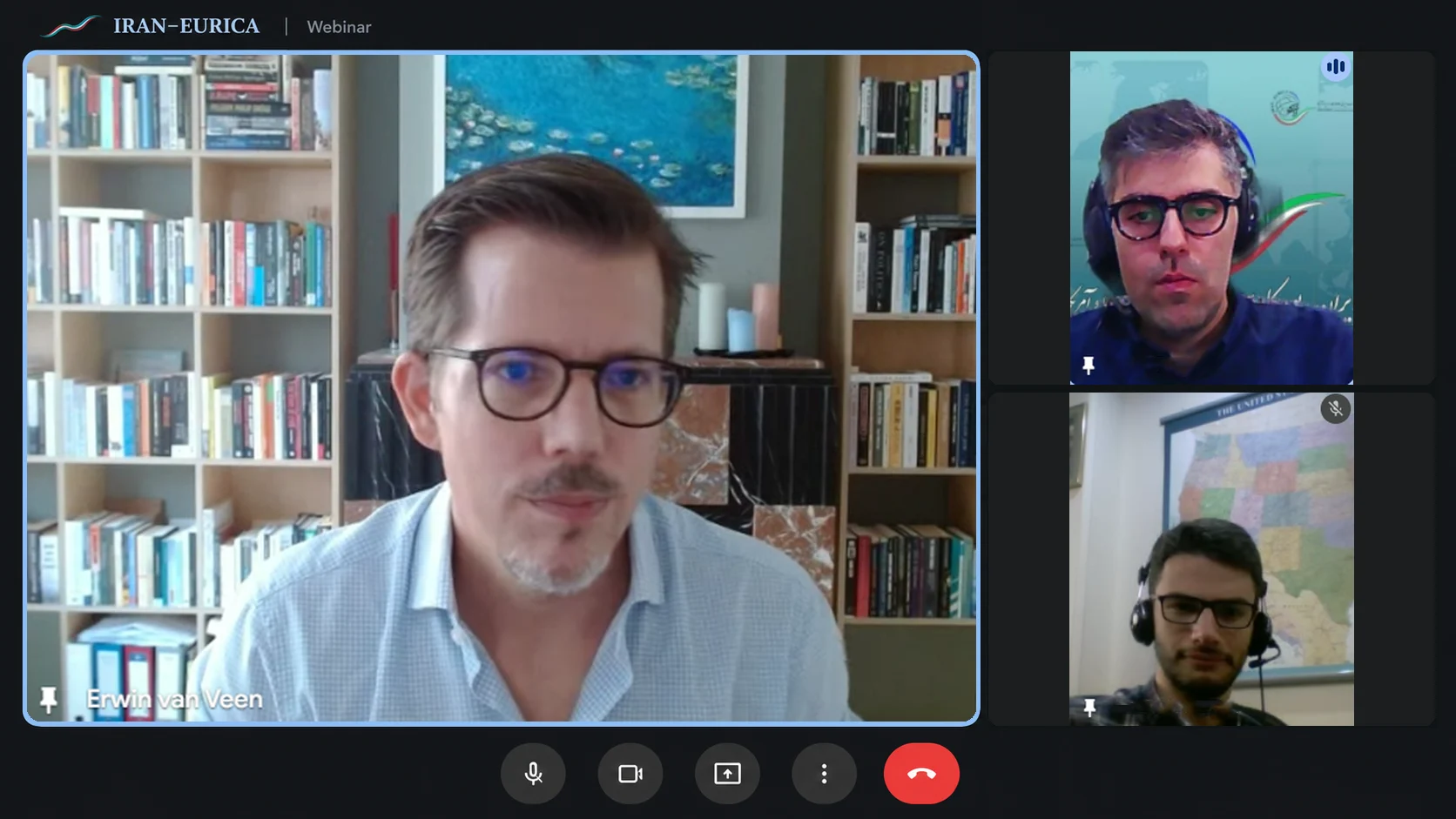
On Wednesday, November 5, 2025, an online meeting entitled “The Future of the Ceasefire in Gaza and the European Approach to the United States’ Strategy” was held at the Institute for Contemporary Studies of Nations (Iran-Eurica), featuring Dr. Erwin van Veen, a senior research fellow at the Clingendael Institute in the Netherlands. The following is a detailed account of the remarks delivered by the guest speaker during the session:
- Key characteristics of the current situation: I think the most important issue is Israel’s intention to transform occupation into annexation, particularly in the West Bank and East Jerusalem. From a Zionist ideological perspective, the West Bank is far more important to Israel than Gaza. For example, Bezalel Smotrich, Israel’s current Minister of Finance, wrote down exactly what he intended to do back in 2017. You can find his plan online. He intends to double the number of settlers, increase the number of settlements and roads, and confine Palestinians to urban centers in the West Bank, such as Ramallah, Jericho, Nablus, and others. The second key characteristic is Israel’s genocidal campaign in Gaza, whose objective was clear from the very beginning: mass displacement, the deliberate targeting of civilians, the use of starvation tactics, and ultimately the expulsion of Palestinians from Gaza and the destruction of their culture, social fabric, and very existence.
- Alongside these two points, two other factors are also extremely important. The first is the widespread denial within Israeli society of what is happening in Gaza. The majority of Israelis are either unaware of or deny the war crimes and genocide. Opinion polls indicate that most believe the Israeli military is performing well in Gaza and protecting civilian lives as much as possible. Some also consider it permissible to starve Gaza until the hostages are released. The next factor is the lack of effective action by the international community. By “effective,” I mean measures that impose material costs on Israel. We have witnessed numerous initiatives, but we should not confuse press statements, conferences, and expressions of outrage over the situation with material measures that increase costs, because they are not the same thing. We are talking specifically about economic sanctions, diplomatic isolation, and ending military cooperation by certain countries, including the Netherlands, but particularly Germany and the United States. These are entirely different measures. Such actions have either not been taken or have not been implemented to the necessary extent.
- Another issue is President Trump’s semi-colonial plan, which, although it has established a ceasefire for the time being, leaves it unclear whether it can actually lead to a just resolution of the crisis. This is because Israeli leaders have repeatedly declared that a two-state solution would only be possible over their dead bodies, and Netanyahu explicitly stated this in the Knesset.
- Israel is facing increasing legal and perceptual pressure. The International Court of Justice has repeatedly declared that the settlements and the separation wall are illegal and that Israel has violated international law by preventing aid from entering Gaza. Israel’s legal and moral case has collapsed. Although this has no immediate practical impact because Israel ignores these rulings, it does influence global public opinion. In countries that support Israel, such as Germany and the Netherlands, we are now witnessing waves of public protests, with hundreds of thousands of people taking to the streets to demonstrate against the killings in Gaza. Although these protests have not yet changed official policies, they indicate a gradual shift in the overall climate. Nevertheless, the international response remains far slower than Israel’s actions. By the time sufficient pressure is applied, it may already be too late, with more Palestinians killed and more land annexed. Looking ahead, two key factors will be decisive: the speed of Israel’s territorial annexation and the extent of Palesatinian resistance, whether civil or armed.
- So, what should be done? What, if anything, can be done in the absence of the United States? In my view, the focus should not be on theoretical solutions, because the Israeli government is openly pursuing annexation and has no willingness to engage in dialogue. The central question is: How can they be brought back to the negotiating table? First: Pressure on Israel must be substantially increased, and I do not mean press statements, but economic and financial sanctions. However, this will not come from governments, because many countries do not want to upset the United States. Such pressure could come from social actors—activists, civil society movements, citizens, and banks that refuse to cooperate with Israeli banks, decline to provide loans or insurance, and sever financial relations—in response to grassroots movements and social boycotts, just as happened during the apartheid era in South Africa. Second: Much greater efforts must be made to redefine the discourse and narrative. We must not forget that the Israeli media are completely dominated by Netanyahu and his allies, while peace-oriented and human rights movements in Israel have been marginalized. A long-term, ten-year program must be developed to rebuild this dialogue, demonstrating that, yes, Israel must have security, but Palestine must have security as well.