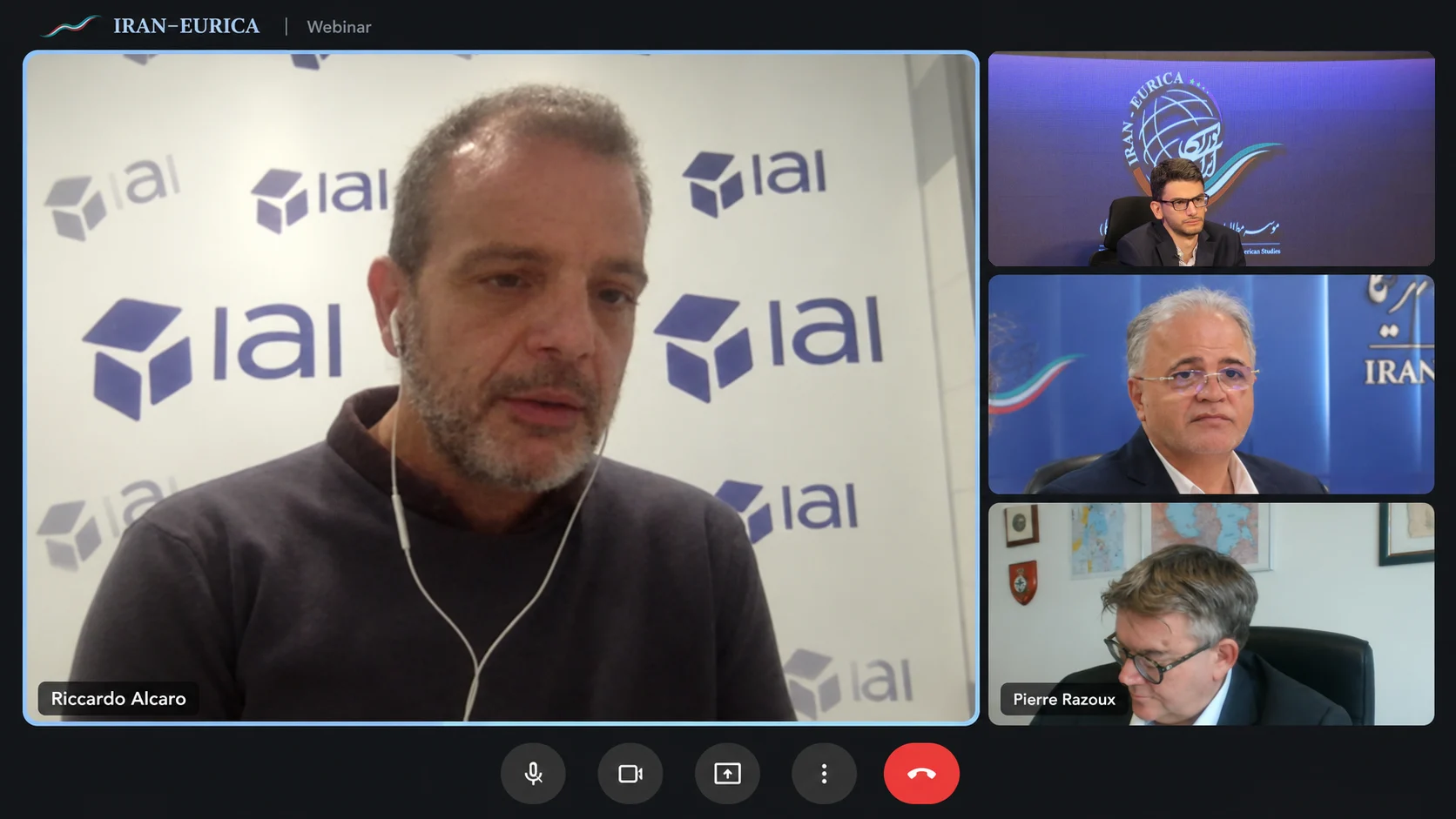
On Wednesday, October 29, 2025, an online webinar entitled “A European Perspective on the Geopolitical Dynamics of the Middle East” was held at the University of Tehran’s Internet Television Studio, featuring Pierre Razoux (historian and senior expert on military and security dynamics in the Middle East), Riccardo Alcaro (senior researcher specializing in international security and transatlantic relations), and Mohammad Reza Haji Karim Jabbari (former Iranian Ambassador to Switzerland and senior advisor to the Iran-Eurica Institute).
During the session, the guests addressed the following questions: Given the rapid transformations in the Middle East’s regional security architecture, shifts in regional alliances, the emergence of geopolitical and geoeconomic rivalries, and the growing role of non-state actors, what kind of security architecture lies ahead for the Middle East? What are the perspectives of the European Union and major European countries on this issue? And what roles will Iran, Israel, the Gulf Cooperation Council (GCC) countries, and non-state actors play in this emerging order?
Dr. Pierre Razoux
There are three factors that, in my view, define the strategic realignments taking place in the Middle East, or West Asia: unpredictability, multi-alignment, and transnationalism. This means less ideology and more pragmatism. Three years ago, the Middle East was defined by two main dividing lines: one between supporters and opponents of Iran, and the other between supporters and opponents of the United States. Today, most countries across this broader region are looking eastward, toward Asia, and placing their eggs in different baskets: the United States, China, Russia, Europe, India, and even Pakistan.
It could be said that Israel and Turkey appear to be the winners of this geopolitical reshuffling. Syria is now the scene of intense competition among Turkey, Israel, the United States, and Saudi Arabia. Erdoğan wants a strong, unified Sunni Syria, whereas Netanyahu seeks a federal, weak, and fragmented Syria. Al-Jolani is caught between his extremist jihadist support base and the need to secure the approval of the United States for the lifting of sanctions. Meanwhile, there is a real risk that ISIS, or the Islamic State, will expand its influence not only in eastern Syria but also in Iraq and Iran.
The Gulf monarchies have shifted their priorities. Their objective is no longer to contain Iran, but rather to avoid any regional war at all costs. They are also focusing on economic restructuring, investment in advanced technologies and artificial intelligence, managing environmental challenges, and addressing population growth.
China could play a greater role in the region because of its substantial investments, but Beijing is reluctant to do so, as Xi Jinping has focused his attention on Taiwan and East Asia.
Russia has lost influence in the region, particularly because of its war in Ukraine, and is now seeking to preserve its two military bases in Syria while simultaneously advancing its strategic interests in Africa, Libya, Yemen, and the Persian Gulf.
India has improved its position in the region. Narendra Modi is regarded as the champion of multi-alignment—he is pragmatic, authoritarian, and does not trouble Middle Eastern leaders with moral values. The India Middle East Europe Economic Corridor (IMEC) is a key project for many regional leaders.
Finally, the United States has demonstrated that it intends to remain the dominant power in the Middle East—at least as long as Donald Trump remains in power. We should also carefully examine what Vice President J.D. Vance will do, because, in my view, he will remain on the scene and a factor in the equation for a long time.
Lastly, the European Union has effectively disappeared from the Middle Eastern landscape, although some European countries, such as Germany, France, Italy, and the United Kingdom, remain active.
Riccardo Alcaro
I believe that, at present, we cannot expect a coherent regional order to emerge in the near future that is, within the next five to ten years. The hostility between Iran and Israel runs very deep. Israel has no desire to compromise and continues to insist on weakening, destabilizing, or even bringing about regime change in Iran. On the other side, there is also little willingness to compromise in Iran, at least under the current circumstances.
With the decision to invoke the “snapback” mechanism at the United Nations Security Council, the European Union appears to have effectively removed itself from the region’s geopolitical equation. Of course, it may be able to return in the future, but only if other actors—particularly the United States—allow it to do so. After nearly twenty years of pursuing a relatively autonomous policy toward Iran and by autonomous, I do not mean completely independent of U.S. policy, but rather following a parallel course the Europeans no longer occupy such a position.
In the past, Europe was aligned with the United States, but not entirely on American terms. In fact, the Joint Comprehensive Plan of Action (JCPOA) was the result of direct engagement between Iran and the United States, but that engagement was made possible only through years of tireless European diplomatic efforts. Ultimately, the Americans entered into negotiations with Iran on terms that were closer to those favored by the Europeans than to their own initial demands. However, following Trump’s withdrawal from the JCPOA in 2018, this process was disrupted and has completely collapsed in recent years.
Dr. Jabbari
Given the current situation in Gaza, the emergence of ISIS terrorists in Syria, and the devastation of Lebanon, Libya, Yemen, Iraq, and Sudan, Europe can no longer claim to be the standard-bearer of “norm-setting in international relations.”
Europe has completely lost its role in shaping international norms, and its credibility at the global level has severely diminished. The activation of the “snapback” mechanism by the three European powers France, Germany, and the United Kingdom demonstrated that Europe is no longer committed to multilateral agreements and diplomatic solutions to major global challenges.
The 12-day war imposed on Iran proved that Iran is capable of defending itself even without nuclear weapons and possesses a high level of deterrence capability. Therefore, the United States will never be able to establish a regional order that completely disregards Iran’s interests.
Unfortunately, Europe’s conduct over the past three years has revealed a profound structural weakness. By completely yielding to American pressure, Europe has not only failed in multilateralism but has also been unable to bring an end to the Russia Ukraine war, which poses a direct threat to Europe’s own security.
Nevertheless, it is not too late. The United States is geographically distant from our region, but Iran and Europe have been neighbors for three thousand years. Iranians have engaged in trade and cultural exchanges with Europe for thousands of years. Iranian culture and civilization have influenced Europe and, in turn, have been influenced by it, and this relationship will continue.
The day Europe acknowledges that Iran has existed in this region and will continue to exist here will be the day that genuine cooperation for regional peace and stability begins.